
Electric vehicles, heat pumps, hot tubs, garage suites, induction ranges, bigger shops, battery systems, and everyday life in general are all pushing more load toward residential electrical services.
Some of that can be handled at the house. Upgrade the panel. Install a larger service. Add load management. Schedule the EV charger intelligently. Those are all useful tools.
But sooner or later, the problem may stop being the panel on the wall and start being the conductor already buried in the ground.
That is where things get expensive fast. Underground service upgrades can mean trenching through landscaping, driveways, sidewalks, lawns, retaining walls, fences, and whatever else has been built above the cable since the day it was installed.
So here is the thought experiment: what if the first question was not “how do we replace the cable?” What if the first question was “can the existing cable safely move more power if we change the voltage?”
The Bottleneck Is Not Always the House
Inside the home, we are already comfortable with the idea of adapting. Panels get changed. Load calculations get revisited. EV chargers can be controlled. Heating equipment can be selected with demand in mind.
The buried conductor is different. It is quiet, expensive to access, and usually ignored until it becomes the limiting factor. Once that happens, the default answer is often bigger wire and a bigger mess.
That may be the right answer in many cases. But it should not be the only idea on the table.
A Simple Voltage Thought Experiment
Power is voltage multiplied by current. If we ignore power factor and losses for a simple comparison, a 48 kVA residential load at 240 volts requires 200 amps.
48,000 VA ÷ 240 V = 200 AMove that same 48 kVA at 600 volts and the current drops to 80 amps.
48,000 VA ÷ 600 V = 80 AThe house does not need to become a 600-volt house. Nobody is suggesting 600-volt receptacles in the kitchen or 600-volt lighting circuits in the basement.
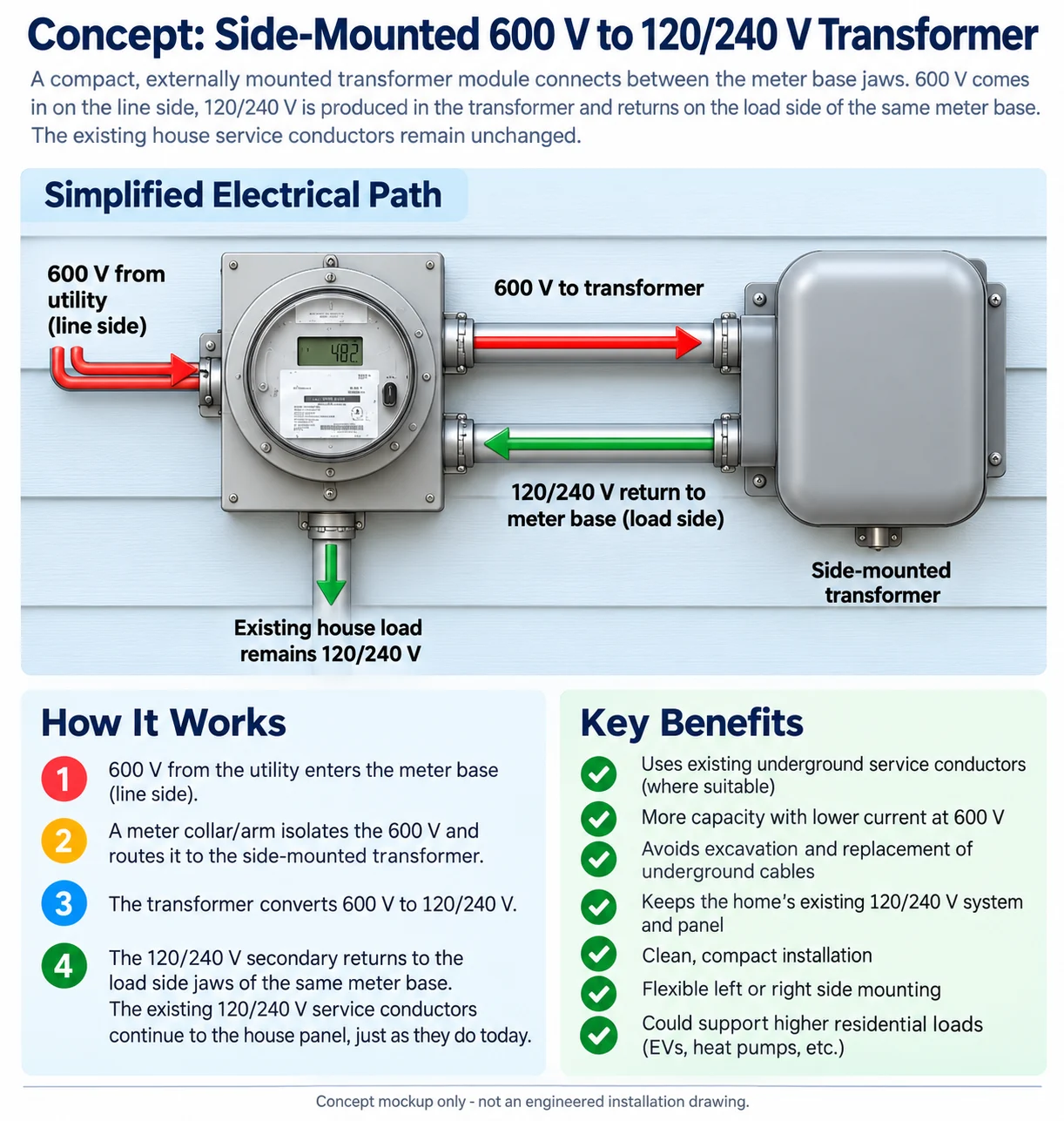
The idea is much simpler than that: use a higher voltage only where it helps move power through the service conductors, then transform it back to the familiar 120/240 volts before it enters the home’s existing electrical system.
The goal is not to reinvent the house. The goal is to ask whether the buried cable can be used more intelligently.
Conceptually, It Could Look Like This
- Existing underground conductor carries a higher distribution voltage.
- A purpose-built outdoor service and metering assembly receives that supply.
- A compact transformer steps the voltage back down to 120/240 volts.
- The home continues to use standard residential electrical equipment on the load side.
In rough form, the path looks like this:
Existing underground conductor → higher-voltage service equipment → step-down transformer → existing 120/240 V residenceThat is not a design. It is not an installation proposal. It is not something to build in someone’s backyard because the math looks interesting.
It is a direction worth testing.
Why the Meter Area Is Interesting
The meter location is already the point where the utility supply and the customer’s electrical system meet. It is accessible, familiar, serviceable, and usually outside. That makes it an interesting place to think about a retrofit module.
A proof-of-concept system could explore a purpose-built outdoor transformer/service assembly located beside the existing meter area. The incoming conductors would remain at the higher voltage until they reached that assembly. The transformer secondary would then feed the house at normal 120/240 volts.
A practical version would need to deal with real-world details: left-side and right-side installations, working clearances, metering requirements, weather exposure, utility access, disconnecting means, grounding, bonding, protection, and equipment certification.
That is exactly why this belongs in the proof-of-concept category first.
The Real Prize: Less Digging
The transformer is not really the star of this idea. The buried conductor is.
If a conductor, its insulation, its splices, its terminations, and the associated equipment can safely and legally operate at a higher voltage, then voltage becomes another possible tool for increasing usable capacity without immediately jumping to conductor replacement.
That “if” is doing a lot of work. This would need serious engineering review, utility involvement, standards review, protection studies, certification, and testing. Existing cable systems are not all the same. Old installations may have unknown splices. Insulation ratings matter. Fault levels matter. Grounding and bonding matter. Metering matters. Losses matter. Ownership boundaries matter.
The idea is not “skip the engineering.” The idea is “do the engineering before we assume excavation is the only path.”
Another Question: Should the Standard Voltage Change?
There is also a bigger, longer-term question hiding behind this idea: should North America eventually rethink its residential voltage standard altogether?
According to the country-by-country overview of mains electricity standards, most of the world supplies premises somewhere in the 220–240 V nominal range, while North America is the major exception with its 120/240 V split-phase residential system. That does not mean we can simply copy and paste another system into existing neighbourhoods. Our equipment, habits, codes, panels, appliances, utility practices, and safety assumptions are all built around the system we have.
But if we are already asking how to serve larger residential loads over the next several decades, it may be worth asking whether standard voltage is part of the conversation too. Maybe the answer is no. Maybe the transition cost is too high. Maybe compatibility wins. Still, it is the kind of question that belongs beside the trenching question, because both are really about the same thing: how much future capacity can we get from the infrastructure already around us?
Why This Is Worth Thinking About
Residential electrical demand is not standing still. More homes will need more capacity, and not every neighbourhood was built with that future in mind.
The brute-force solution is simple: install larger conductors everywhere. Sometimes that will be necessary. But in established areas, that can also mean a lot of cost, disruption, restoration work, and customer frustration.
So the useful question is not whether 600 V AC is automatically the answer. It may not be. There may be better architectures. There may be cases where the economics do not work. There may be technical constraints that make the idea impractical for many existing services.
But the question itself is worth asking clearly:
Before we dig up the cable, can we move the same power through suitable existing infrastructure by increasing voltage and reducing current?
That is the thought process. Not a finished design. Not a sales pitch. A practical challenge to the default assumption that more residential capacity always starts with a trench.