
If you have ever plugged in a kettle and a toaster at the same time and watched the breaker give up, you have already met the reason kitchen wiring gets special attention. A split plug, more properly called a split receptacle, is one duplex outlet where the top and bottom halves are not simply sharing the exact same feed.
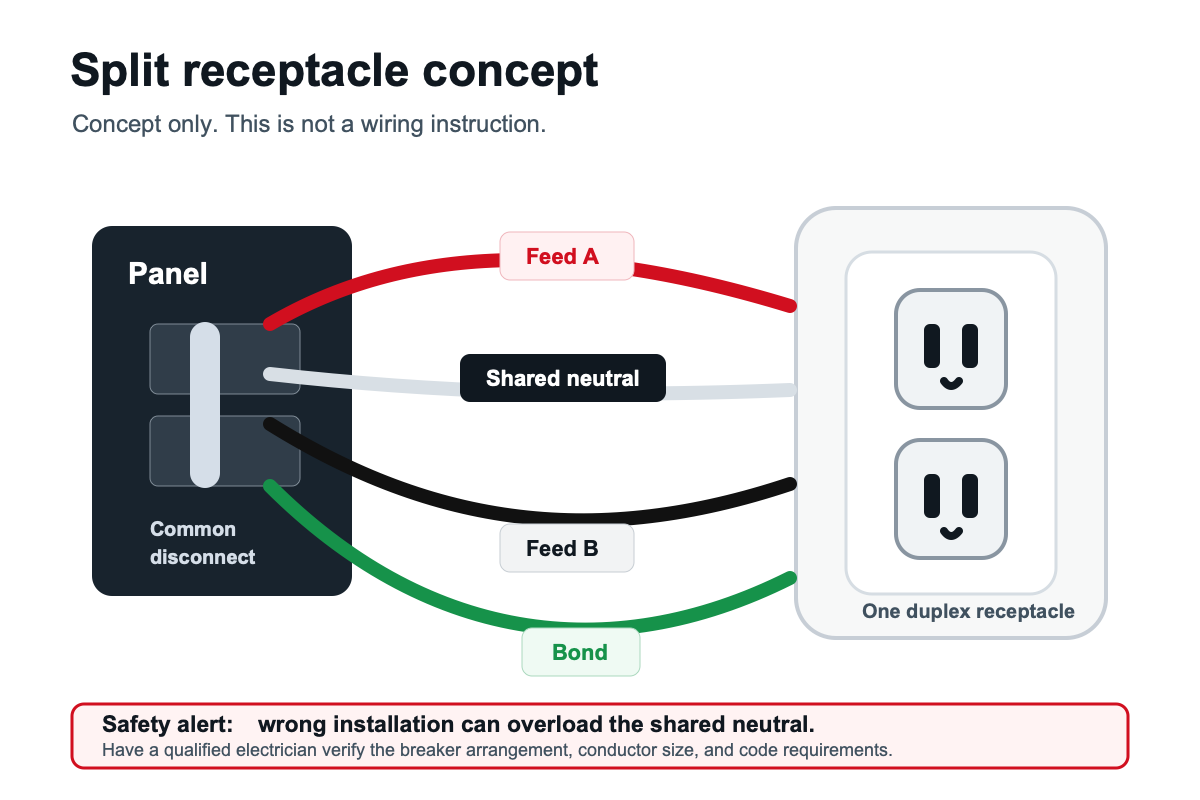
Safety alert: a split receptacle must be installed with the correct breaker arrangement and opposite circuit legs. If it is wired incorrectly, the shared neutral can end up carrying the combined load from both halves of the receptacle. That can push the neutral beyond the ampacity it is rated for, potentially close to double the intended load, which can overheat the conductor and cause melting or fire damage at the receptacle or inside the box. This is electrician territory, not a guess-and-check repair.
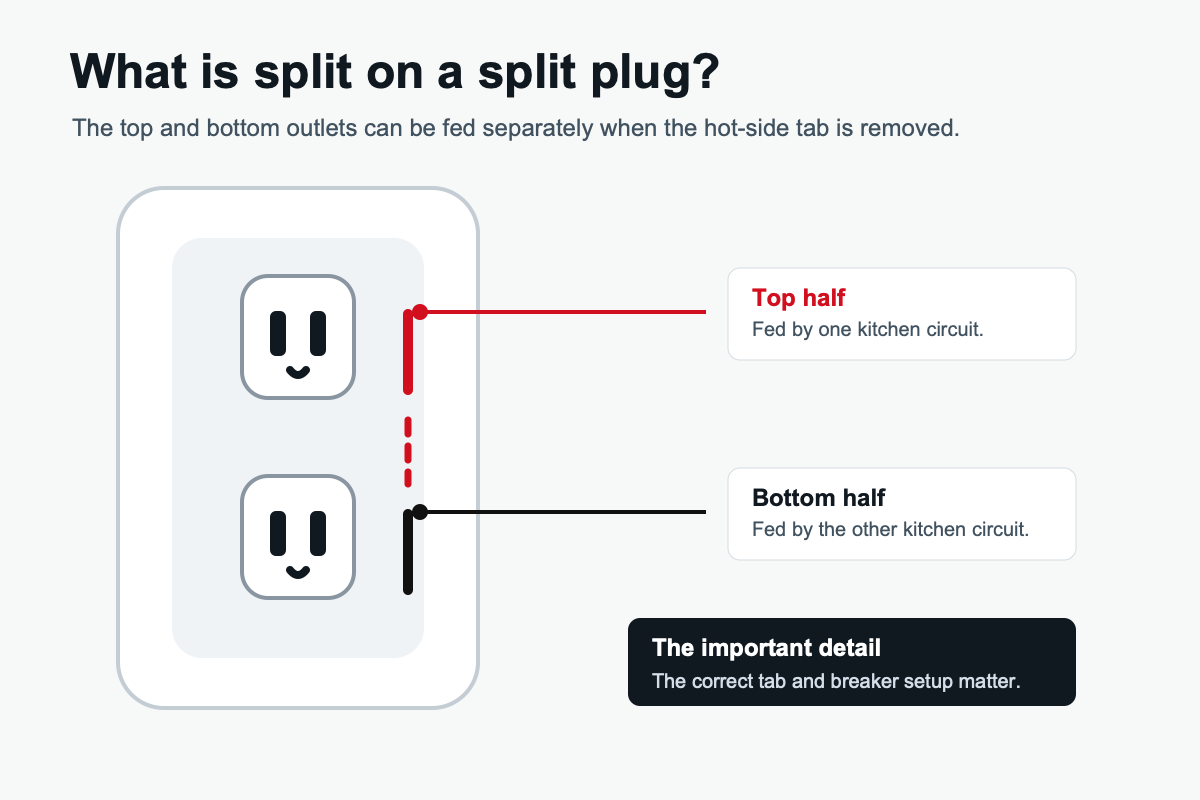
The simple version
A normal duplex receptacle has small metal tabs that connect the two outlets together. On a split kitchen receptacle, the hot-side tab is removed so the top half and bottom half can be supplied by separate conductors. In many older Canadian kitchens this was done with a red and black hot conductor, a shared neutral, a bond conductor, and a proper two-pole breaker or common disconnect.
That last part matters. A split plug is not just a regular outlet with a tab broken off. The breaker, conductor size, neutral, bonding, GFCI/AFCI requirements, and local code all need to line up.
Why kitchens need more than one good circuit
Kitchens are hard on electrical systems because so many countertop appliances turn electricity directly into heat. Kettles, coffee makers, toasters, air fryers, deep fryers, griddles, pressure cookers, and microwaves can all draw a serious load. One appliance may be fine. Two or three running together can be enough to trip a breaker, especially in an older home.
Older homes often were not built around today’s appliance habits. A kitchen might have had a toaster, a percolator, and a few lights. Today a normal morning can involve a kettle, espresso machine, toaster oven, and air fryer before anyone has even found their keys.
One split circuit versus a well-planned kitchen
If you are lucky, your kitchen has more than one dedicated countertop circuit. Better yet, it may have two sets of properly planned kitchen circuits so the load is spread around the room instead of crammed onto one tired breaker.
In some homes that shows up as split receptacles on two-pole breakers. In newer or renovated kitchens, the solution may be dedicated 20 amp kitchen receptacle circuits instead, depending on the code requirements and how the kitchen is laid out. The goal is the same: give the appliances that create heat enough circuit capacity to do their job without nuisance tripping or unsafe loading.
How can you tell if your kitchen has split plugs?
Sometimes you can spot clues at the panel. You may see a two-pole breaker, tied breakers, or labels like kitchen counter, counter plugs, or split receptacles. At the receptacle itself, you cannot safely confirm the wiring just by looking at the front. The important parts are inside the box and at the breaker.
If your countertop plugs trip often, feel warm, look damaged, or struggle when more than one appliance is used, that is worth having checked. The fix may be simple, or it may point to an older kitchen that needs better circuit planning.
The takeaway
A split plug is one of those electrical details that exists because kitchens are demanding. It gives one duplex receptacle more useful capacity when installed correctly, and it helps high-draw appliances share the load more intelligently.
When accuracy and safety matter, this is not guesswork. Have a qualified electrician confirm what you have, what code requires, and whether your kitchen is ready for the way you actually use it.